Obama says “They’re real”; Trump reacts and promises to release UAP files
Barack Obama calls UAPs 'real' on a podcast; the phrase goes viral and gets walked back. Trump accuses him of leaking classified information, then promises to release government files. Harvard astrophysicist Avi Loeb argues there is no sustainable position left for secrecy. Here, I separate the facts from the noise — and share the pattern I see forming.
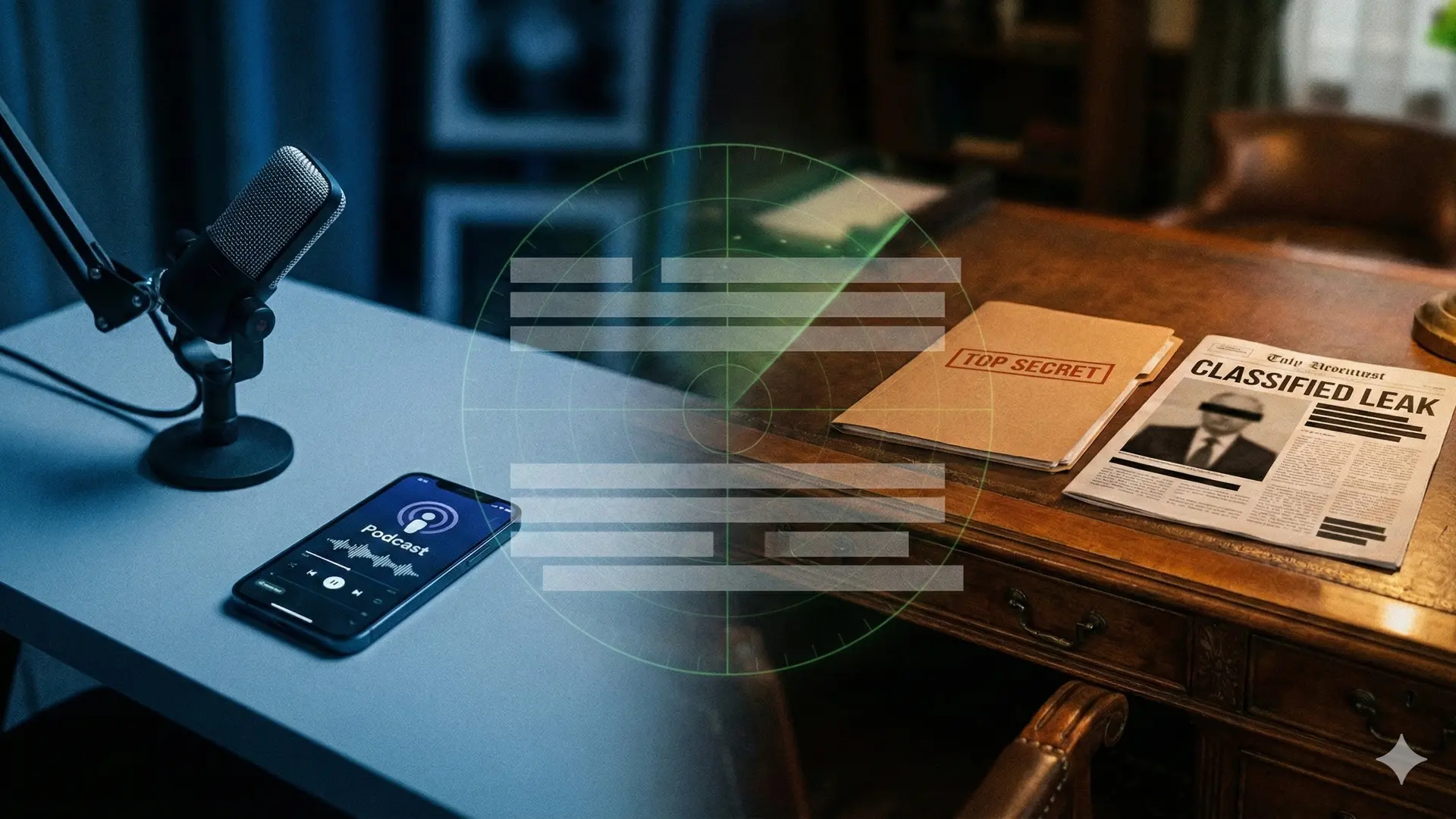
Sometimes what looks like noise is actually a signal.
In the span of a single week in February 2026, a casual podcast answer from Barack Obama became global headline fuel, forced a public clarification, drew an accusation from Donald Trump, and culminated in a presidential promise to release government files on UAPs. Each move triggered the next, like dominoes set up on the same table.
This piece walks through the facts in order — and then I share the pattern I think I see forming. I'll be explicit about what is record and what is my reading. You decide what to make of it.
Timeline at a glance
- Obama (podcast) → viral quote: "They're real, but I haven't seen them."
- Media cycle: headlines amplify the literal reading — and frame it as "confirmation."
- Clarification: Obama narrows the scope: "I have seen no evidence of extraterrestrial life or contact."
- Trump (tarmac): accuses Obama of leaking classified information.
- Trump (Truth Social): announces he will direct the release of government files on UAPs/UFOs.
- Avi Loeb (Harvard): frames the logical endgame — whether it's ET or human technology, secrecy is unsustainable.
What Obama said (and why it landed like a grenade)
On Brian Tyler Cohen's podcast, Obama was asked whether aliens are real. His answer was short, direct, and — critically — made for clipping:
They're real, but I haven't seen them.
Barack Obama, in conversation with Brian Tyler Cohen
In the longer exchange, he jokes about Area 51 and about the idea of "an enormous conspiracy" that could have been hidden even from the President of the United States.
The key point is context: this was a relaxed, informal conversation. A single sentence, when separated from tone and framing, can read as a technical assertion. And the first half — "they're real" — is, on its own, unambiguously affirmative.
How it became headlines
The reaction was immediate. Multiple outlets reported a renewed "media stir" about UFOs and extraterrestrial life — not because new evidence emerged, but because the speaker carries symbolic weight. A former president of the United States saying "they're real" is not a data point. It's a cultural event.
A quote can matter because of who said it and what it set in motion — without being proof of what it seems to imply.
The walk-back
After the viral wave, Obama drew a clearer boundary: he has seen no evidence of extraterrestrial life or contact. One line attributed to that clarification captures the new landing zone:
Statistically, the universe is so vast that the odds are good there's life out there. But the distances between solar systems are so great that the chances we've been visited by aliens is low, and I saw no evidence during my presidency that extraterrestrials have made contact with us.
Barack Obama, follow-up clarification (as reported)
Notice the structure. The original statement is broad and conversational. The clarification is narrow, precise, and legally defensible. Asserting "they're real" is not the same as claiming evidence of contact — which would require proof.
Was the first phrase a slip? Was the clarification damage control? Or was the sequence itself the point? Hold that thought.
Trump on the tarmac
A few days later, Fox News reporter Peter Doocy caught Trump on the tarmac and asked about Obama's statement. The exchange was brief. In the clip below, Trump says he doesn't know whether the claims are real, but frames the issue differently: Obama, he says, was providing classified information. "He's not supposed to be doing that."
Trump's response had two distinct moves:
- The accusation — Obama shared classified information:
Well, he gave classified information. He's not supposed to be doing that.
Donald Trump, as reported
- The announcement — on Truth Social, Trump posted that he would direct officials to begin identifying and releasing government files on UAPs/UFOs:
Based on the tremendous interest shown, I will be directing the Secretary of War and other relevant Departments and Agencies to begin the process of identifying and releasing Government files related to alien and extraterrestrial life, UAPs and UFOs…
Donald Trump (Truth Social)
Pay attention to what Trump didn't do here. He didn't ridicule the topic. He didn't dismiss it as fantasy. He treated it as serious enough to justify a formal government process. That shift — from joke material to governance question — is itself significant.
The no-escape logic (Avi Loeb, Harvard)
Now step back from the politics for a moment and consider a purely logical argument — one that doesn't require picking a side.
The argument comes from Avi Loeb, the Frank B. Baird Jr. Professor of Science at Harvard University — one of the most prominent astrophysicists in the world. He led the Harvard Astronomy Department for nearly a decade, founded the Black Hole Initiative, and has published hundreds of peer-reviewed papers. He also leads the Galileo Project, a systematic scientific effort to search for evidence of extraterrestrial technological signatures using dedicated observatories in Massachusetts, Pennsylvania, and Nevada. He is not a fringe voice. He is as mainstream-credentialed as a scientist can be.
In the clip below, from his official YouTube channel, Loeb lays out a straightforward argument about the UAP situation. The logic goes something like this:
If UAPs are extraterrestrial — genuinely non-human technology — then you are looking at the most consequential discovery in human history. You cannot justify keeping it from the public indefinitely. The truth belongs to humanity, not to a classified compartment.
If UAPs are human technology — some terrestrial power's advanced craft — then you have a different but equally serious problem: someone is routinely violating sovereign airspace, including that of the world's most powerful military, and the government has been unable or unwilling to stop it. That is either incompetence or complicity — and both demand accountability.
Either path leads to the same place: inaction is no longer defensible. The only viable move is some degree of openness.
This isn't about belief. It's about logical structure. Whatever UAPs turn out to be, the arguments for continued secrecy are running out of room.
The pattern I see
Here is where I step out of reporting and into perspective. I'll be clear: what follows is my reading of the situation — a pattern I'm constructing from the data points above. It is not a claim of fact. I'm inviting you to examine it with me.
What struck me about this entire sequence is how synchronized it feels. Not necessarily coordinated — I'm not suggesting anyone sat in a room and planned the chain of events. But the actors appear to be playing the same game, on the same board, with moves that reinforce each other. You don't need a conspiracy for that. You just need people who understand the rules.
Consider the sequence:
Obama throws the grenade
He says "they're real" in a setting relaxed enough to sound candid, not official. The phrase is short, clip-friendly, and impossible to ignore. Then he walks it back to a legally defensible position. But the impact — or perhaps the intended effect — is already done: the topic is back in the global conversation at the highest symbolic level.
The reporter puts Trump on the spot
On the tarmac, the question is inevitable. And Trump's answer is revealing: he doesn't dismiss, he doesn't mock. He frames it as a matter of classified information and national gravity. Whether calculated or instinctive, the effect is the same — the topic gets treated as serious by both sides of American politics, simultaneously.
Trump makes the move
He announces the process to release files. Reports have attributed to him, at earlier points, a reluctance to declassify certain material — a sense that the issue was bigger than the presidency, that it would create too many problems. Now he signals openness. Something changed in the environment that made this move possible — or advantageous.
Avi Loeb closes the logical circle
His argument provides the intellectual framework for why all of this was, in some sense, inevitable. The walls are closing in on secrecy from both directions: the extraterrestrial scenario demands transparency, and the human-technology scenario demands accountability. There is no stable position left for "we can't talk about this."
To me, this looks less like chaos and more like a phase transition. Each actor plays their role — some may be deliberate, some reactive — but the system as a whole moves in one direction: toward some level of disclosure. Not because anyone is being altruistic, but because the logic of the situation demands it.
I could be wrong. This is a perspective I'm building, not a conclusion I'm selling. But the pieces fit in a way that is hard to dismiss as coincidence.
What "release the files" would actually require
If this pattern holds, the next question is practical: what would "transparency" actually look like when the information lives inside classified programs, protected by NDAs with severe penalties?
The honest answer is: you can't just dump everything. And Loeb, in the same video, explains why with clarity. Much of the UAP data was collected by state-of-the-art classified sensors — satellites, reconnaissance systems — whose resolution and capabilities are themselves national secrets. Releasing a satellite image of an anomalous object would also reveal how sharp that satellite's eye is, handing adversaries a blueprint of American surveillance limits. On top of that, intelligence administrators who cannot identify what they're seeing have an institutional incentive to keep the data classified: admitting "we don't know what this is" is admitting a gap in national defense — and nobody wants Congress looking over their shoulder asking why billions in defense spending didn't produce an answer.
So "release the files" cannot mean "release everything." An executive order would have to be more surgical than that.
But here is where Loeb offers the president a practical path forward: declassify the old data. Any technology — sensors, platforms, detection methods — used 50 years ago is so obsolete that revealing it poses zero risk to current national security. And if the extraterrestrial hypothesis has any merit, those decades-old archives likely contain incidents, images, and measurements that could be analyzed with today's tools for the first time.
This is not just an abstract argument. Loeb explicitly offers to help. Through the Galileo Project, his team has built observatories and AI-driven analysis pipelines designed to detect outliers — objects that don't match any known human technology. He states openly that he would be delighted to work with the White House and help analyze any declassified material, whether it turns out to be human-made or something else entirely.
The legal dimension remains. Many people who have spoken publicly about UAP inside knowledge — including self-described whistleblowers — argue that the central blocker is a legal trap: classified programs + non-disclosure agreements + career-ending consequences. "Tell the truth" is not just a moral ask. It requires a legal pathway that changes the risk calculus for the people who hold the information.
One mechanism discussed within this ecosystem is a presidential executive order designed to:
- Create explicit safe harbor for disclosing specific categories of UAP-related information through lawful channels,
- Align agencies around what can be shared and how,
- Reduce the ambiguity that keeps people silent even when they say they want to talk.
The beauty of Loeb's suggestion is that it gives the president a concrete first step that sidesteps the hardest objections. You don't need to reveal current capabilities. You don't need to expose active programs. You start with data old enough that national security is no longer a valid shield — and you let serious scientists do what they do best: analyze it.
The real test of this moment is not the announcement — it's what follows. Will Trump issue an executive order that makes disclosure legally viable? Will it start with the low-hanging fruit of historical data? Or will "release the files" remain a promise without a mechanism?
The answer will tell us whether we are watching a genuine opening — or another chapter in a long history of controlled ambiguity.